Last updated on October 6, 2025
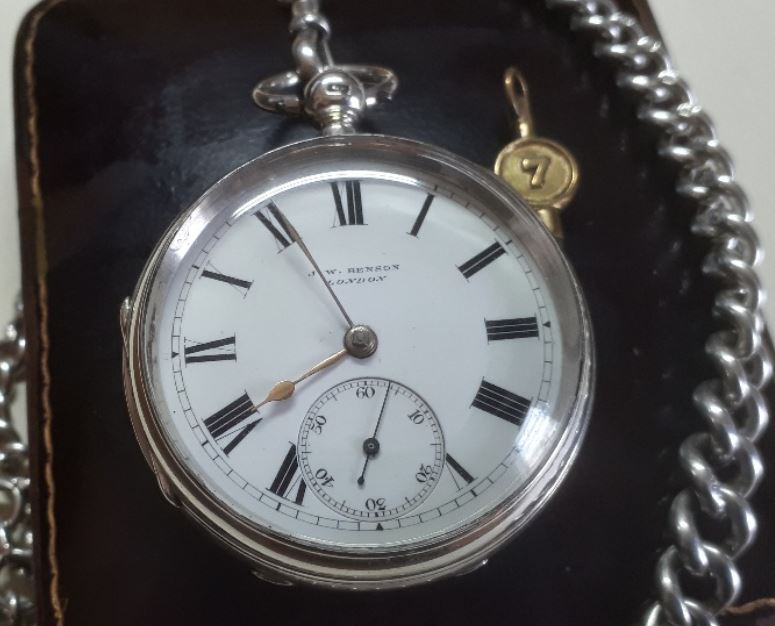
This antique fusee pocket watch from J W Benson is very impressive. It presents well, with no sign of damage and maintains good time. It is a key wind, key set movement. The J W Benson brand is a must for any collector of English antique pocket watches. This one is part of my personal collection.
Fusee movement
The watch has a fusee movement, signed “J W Benson, maker to The Queen and The Prince of Wales”. A fusee is a mechanism intended to minimise the effects of reduced power as the mainspring winds down. As a result, this helps to maintain accurate time-keeping.
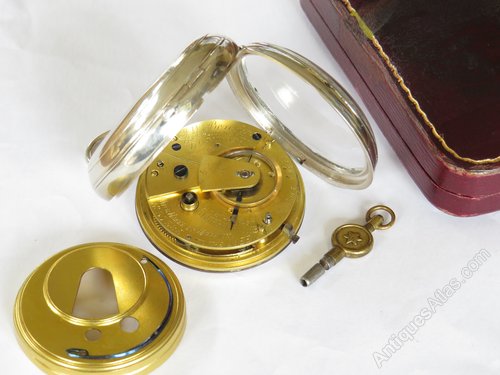
The mainspring barrel is connected to the fusee, a conical wheel, via a tiny chain. The fusee then connects to the gear train. When the mainspring is fully wound, most of the chain is wound around the fusee all the way to the narrow top of the cone. As the watch runs, the chain unwinds down to the wider end of the fusee cone as the chain wraps around the mainspring barrel. This has the effect of equalising the power transmitted to the gear train, because the lever arm of the chain pulling the fusee is shorter when the mainspring is fully wound, and longer when the mainspring is unwound (What is a fusee watch movement at Caliber Corner).
Case
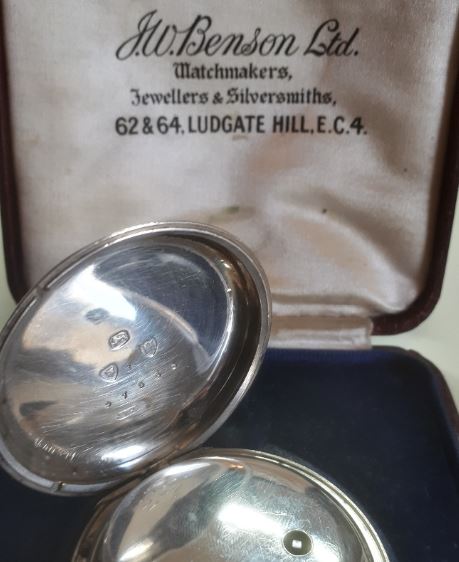
The watch measures 50mm in diameter, excluding the stem and the loop. The case material is silver, and there are British hallmarks inside both of the case backs for London 1883 with a sponsor’s mark for J W Benson. The movement is protected by an outer case back and a fitted inner dust cover or cuvette. I am not yet at the point where I am confident enough to remove the movement from the case, especially as the watch is running so well (What is a hallmark? at the London Assay Office).
J W Benson
J W Benson was founded by brothers James William Benson and Samuel Suckley Benson in 1847. They promoted themselves as watchmakers, gold and silversmiths of Cornhill in the City of London. In addition to retailing their own watches and jewellery, they were also importers and retailers, dealing in fine gemstones and precious metals. The partnership was dissolved after just eight years in 1855, and J W Benson carried on alone. Benson was considered one of Victorian London’s most prestigious retail jewellers, and he also possibly manufactured his own watch movements. The company flourished. As a result, Benson boasted an elite client base of British and European royalty, celebrities, wealthy industrialists and businessmen (Benson, JW at Hancocks, London).
Condition
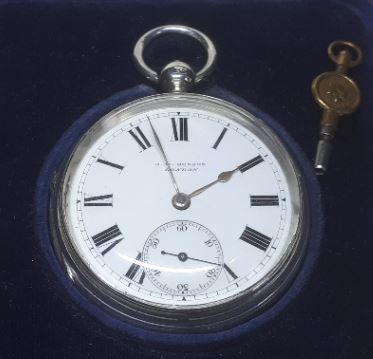
The case has a couple of very minor bruises to the back, but overall, the condition is very acceptable for a piece from 1883. The glass crystal lens is in lovely condition with no obvious scratches visible to the naked eye. The dial is also crisp, with no visible fading to the maker’s name. As a result, it’s a very presentable watch with only a few signs that it has been worn and used over many years. The pocket watch also includes an antique J W Benson box of leather and silk. The box is likely to be the original as it includes the address of 62 and 64 Ludgate Hill, which fits the hallmarked date of the watch.
Timekeeping
The case back opens by depressing the button on the stem. English fusee movements are key wound and are generally wound counter-clockwise. Because of the gear effect of the fusee, the tension on the spring remains constant when winding. As soon as resistance is felt, you should stop winding to prevent damaging the chain. I performed a 24-hour time test on this antique pocket watch and was very pleasantly surprised at the results. I set it to the time on my modern Oris 65 automatic divers watch, which generally gains 3 seconds per day. Over 24 hours, the J W Benson was just 20 seconds behind the Oris. A loss of 17 seconds a day on a watch that is 137 years old is incredible. The total power reserve from a full wind was thirty hours, something that I find totally acceptable for an antique pocket watch.
Not only is it presentable, but it’s also a very accurate timepiece. The other nice thing is that the watch is sitting next to me as I type, and I can hear it ticking away. There is not a whisper coming from my modern Oris. In conclusion, this is a very pleasing addition to my collection.
Related content
J W Benson at the British Museum.

Dear Sir,
Thank you for publishing this information.
I have a watch which is almost the same. The only difference is that mine does not have a makers name at the dial.
I wish to sell mine. It has been sitting in a drawer for the last 45 years. Could you advise me on what would be a fair price to ask?
Best regards from The Netherlands,
Menno
Hi Menno,
Its hard to answer the question on value, but threre are a few questions to ask. Do you know the date of the watch? Is it a fusee pocket watch? What material is the case made from? Is it working? When was the last service?
If you know these answers you can search for completed sales results to get an idea of the value of your watch. For example, I might Google “J W Benson silver fusee pocket watch 1883”. Focus on completed sales results to see what similar watches actually sold for. Sadly, these watches are not worth life changing amounts. And servicing, if required, can cost as much as the watch is worth. I suspect that if it has been sat in a drawer for 45 years, then servicing would be required either by yourself or a future owner. I hope this helps, Jason
Dear Jason,
Thank you so much for your reply. I didn’t see until today. Sorry for that.
I’ll do as you suggest and hope to become any wiser.
Beste regards,