Last updated on June 3, 2026
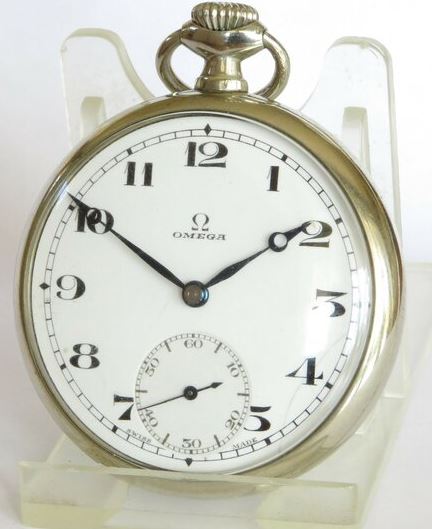
It was a quiet week in the Set Back in Time camp, not much of interest came across our respective desks. However, during our Saturday afternoon session, we came across this simple yet functional Omega nickel pocket watch, which has a lightly patinaed dial in good condition. The watch has an Omega calibre 40.6L stem-winding movement, which is working nicely. The movement is fully signed, and it has an Omega serial number, dating it to 1923. We did some research on this particular watch, and below is what we uncovered.
A brief history of Omega
Omega’s story began in 1848, when Louis Brandt opened a workshop in La Chaux-de-Fonds and assembled key-wound pocket watches from locally sourced parts. After he died in 1879, his sons relocated the firm to Biel/Bienne, where they modernised production and brought manufacturing under one roof. In 1894, the Brandt brothers introduced the “Omega” movement, which featured interchangeable components and exceptional timekeeping accuracy. Its success prompted the company to adopt “Omega” as its official name in 1903 (Omega at Grail Watch Wiki).
Omega expanded quickly in the early twentieth century and became the official Olympic timekeeper in 1932. The company produced highly accurate wristwatches, marine chronometers, and pilots’ watches and supplied military timepieces during both World War I and World War II. In 1957, Omega introduced the Speedmaster, Seamaster, and Railmaster collections. The Speedmaster achieved fame in 1969 as the first watch worn on the Moon by Apollo 11 astronaut Buzz Aldrin. Omega struggled during the quartz crisis of the 1970s and 1980s, finding it difficult to compete with inexpensive Japanese quartz models. The brand’s prestige suffered, and Omega was absorbed into the Swatch Group in the late 1980s (Omega at Chronopedia).
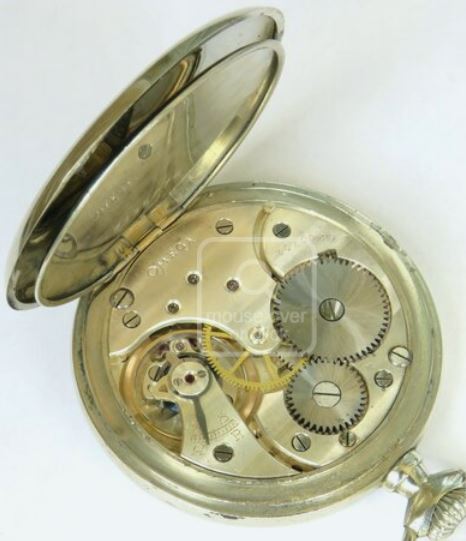
Omega calibre 40.6L
The watch features an Omega calibre 40.6L manually wound movement with a Swiss lever escapement, 15 jewels, a bi-metallic compensation balance, a Breguet hairspring and a frequency of 18,000 vph. The movement is protected by an inner hinged cover. The Omega 40.6L was in production between 1923 and 1936 with an estimated quantity of approximately 1,000,000 units. The movement is gaining just over 30 seconds over 24 hours, not bad for a timepiece over a hundred years old (Omega calibre 40.6L at Ranfft).
Case and dial
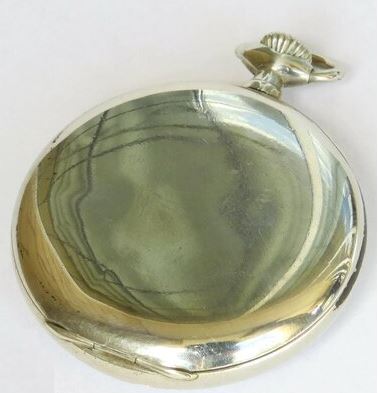
The watch measures 48.5mm in diameter, excluding the winding stem and the loop. The case material is nickel. The front and sides of the case are in good condition. However, the hinged case back has some minor unevenness. The inside of the case back has the early Omega logo. The acrylic lens is in good condition. The signed dial has blued steel Breguet-style hands, a subsidiary seconds dial, italicised Arabic numerals and an outer minute track. There is a faint hairline crossing the 4 marker between the 3 and 5 markers.
Nickel case
The nickel case is an interesting material. It is much more durable than precious metal and therefore more suited to an “active” lifestyle. Pure nickel naturally resists corrosion because a protective layer of nickel oxide forms on its surface. This thin oxide layer effectively prevents further damage to the underlying metal. In its pure form, nickel displays a slightly yellow hue similar to pale brass. To achieve a more upmarket look, nickel was alloyed with other elements to create a whiter appearance, more like traditional silver. These alloys were widely known as “nickel silver” and were popular because, despite the precious silver-like finish, they were resistant to tarnishing and were more resistant to scratches. The nickel silver alloy used in watch cases typically consists of sixty per cent copper, twenty per cent nickel, and twenty per cent zinc (Nickel at Wikipedia).
The term “German silver” acknowledges the nineteenth-century metalworkers who first developed this specific nickel silver alloy. In France, craftsmen often refer to the material as Argentan or Maillechort. This second name honours the French chemists Maillot and Chorier, who formulated their own version of the alloy in 1820. These various names reflect the international effort to perfect this popular and versatile watchmaking metal.
Summary
This Omega nickel pocket watch is a practical timepiece. It has a reliable Omega calibre 40.6L, which should give years of accurate timekeeping. The nickel case is what defines its practicality. Nickel is a more durable case material than the softer silver. Despite its wearability, it will still, when polished, give the impression of a precious metal case. This is the sort of watch worn by a practical man, someone who possibly had an active job, but also someone who needed to be punctual. It was a reliable and durable timepiece in the 1920s and remains so now.
Related content
Omega history at Omega Chronicle.