Last updated on June 7, 2026
The Tudor name has rarely appeared in the pages of Time Worn Watches. That is not because we don’t respect the name. It’s just that this website is purely about antique watches (100+ years). Until this year, the Tudor brand has not qualified as antique. This year, the watchmaking world celebrates the centenary of the Tudor brand. In advance of some potential posts on antique Tudor watches, we thought we might explore the history of the brand. Here is what we have uncovered about Tudor watch history.

Tudor watch history
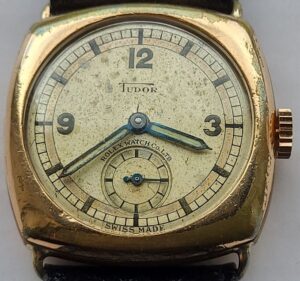
According to Mikrolisk, Swiss watchmaker Veuve de Philippe Hüther registered the Tudor trademark in 1926. This was on behalf of Hans Wilsdorf, the founder of Rolex. Wilsdorf envisioned Tudor as a brand that would offer the reliability and quality of Rolex watches at a more affordable price point. During the early 1930s, Australia served as the primary market for Tudor watches. The company officially transferred the trade name “The Tudor” to Rolex in 1936. In 1946, Wilsdorf officially founded Montres Tudor SA. This set the stage for Tudor to become a significant player in the watchmaking industry.
Collections
Tudor marked its early years by introducing the Oyster collection in the late 1940s. These watches used the waterproof “Oyster” case design that Rolex had previously held exclusively. Soon after, the brand released the Tudor Oyster Prince in 1952, incorporating an automatic movement (modified Fleurier calibre 390). Following the Oyster Prince, the Tudor Submariner was launched in 1954. The Submariner was a diving watch that became a favourite among professional divers and military personnel (Tudor Watches at Wikipedia).
The Submariner’s design evolved over the years, adding features like the “big crown” and “snowflake hands”. These features have become iconic elements of Tudor’s design philosophy. During this period, various navies, including the US Navy SEALs and the French Marine Nationale, issued Tudor watches to their personnel.
In 1957, the brand developed the Tudor Advisor, a watch with an alarm complication. This demonstrated Tudor’s commitment to delivering functional designs. In the 1970s, Tudor expanded its offerings by introducing its first chronograph, the Oysterdate. This featured a manually wound Valjoux mechanical calibre 7734.
Market segment
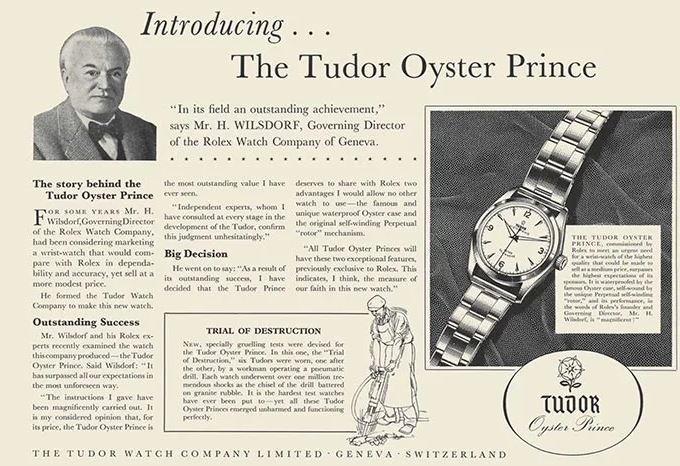
“For some years now, I have been considering the idea of making a watch that our agents could sell at a more modest price than our Rolex watches”. These words, from Hans Wilsdorf, perfectly describe the purpose of the brand created in 1926 (Tudor at Watch Wiki).
Tudor has emerged as a rising star in recent years. It delivers a competitive blend of style, Swiss watchmaking expertise and exceptional value. Only a few years ago, the brand sat in the shadow of its older sibling, Rolex. Tudor models remain more affordable than the timepieces that carry the iconic crown logo. However, they possess a distinct character and offer immense appeal to the sartorially conscious watch buyer. This surging interest in the brand has also sparked a renewed demand for vintage Tudor models, driving up prices for rare examples with attractive patina.
Classic Tudor models
Over the decades, Tudor introduced a range of standalone collections. These transformed Tudor from a “cheaper” Rolex alternative into a respected brand in its own right. The most notable models were the Oyster Prince, the Submariner, and the Ranger.
Oyster Prince
Hans Wilsdorf launched the Oyster Prince in 1952, marking a fundamental moment for the brand. This range successfully combined the waterproof Oyster case with the self-winding Perpetual rotor. These were features that Rolex had previously held as its own. To demonstrate the watch’s resilience, Tudor subjected the Oyster Prince to a series of punishing tests. This included a “Trial of Destruction” advertising campaign and equipping the British North Greenland Expedition. These real-world challenges solidified the model’s reputation as a dependable tool in the most punishing conditions (The Tudor Oyster Prince at Tudor).
Submariner
Following this success, Tudor introduced the Submariner in 1954 to satisfy the growing demand for professional diving instruments. The Tudor Submariner shared some features with its Rolex namesake. However, it eventually developed its own identity through experimental features such as the bold “Snowflake” hands. These square-ended hands and markers improved visibility for divers working in murky waters. This practical design choice, combined with the watch’s solid build, was popular with military forces. The French Marine Nationale and the US Navy issued the Submariner as standard equipment for their elite divers for decades.
Ranger
In the 1960s, Tudor further diversified its range by releasing the Ranger. A watch designed for the rugged demands of a field explorer. The designers focused on legibility, introducing a matte black dial with large, luminous Arabic numerals at the three, six, nine, and twelve o’clock positions. This “3-6-9-12” layout, paired with unique “arrow” hands, created a budget-friendly alternative to the Rolex Explorer. Today, collectors value the vintage Ranger for its minimalist design and rugged functionality.
Summary
None of the Tudor Oyster Prince, Submariner or Ranger ranges will enter these pages soon as a verifiable antique. However, Tudor is a very respectable brand and is admired by watch collectors across the globe. In 2026, Tudor celebrates its 100th anniversary, transforming from a subsidiary of Rolex into a watchmaker that dominates the “attainable luxury” segment. It serves as the premier choice for watch enthusiasts who value technical innovation and heritage over a pure status symbol. Here at Time Worn Watches, we hope to feature an antique Tudor watch in these pages very soon. We welcome Tudor to the Hundred Club and the world of antique watches.
Related content
Tudor website.