Last updated on June 30, 2026
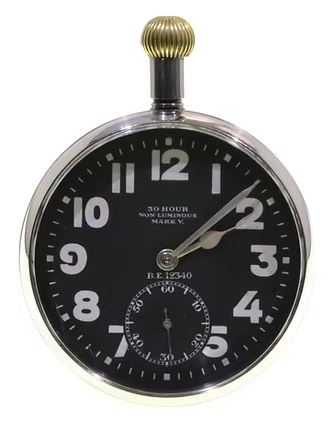
World War I cockpit watches don’t often come up in Time Worn Watches meetings. However, this week, one of the group members brought our attention to this Doxa RFC cockpit watch, dating from 1916. It is a Mark V 30-hour non-luminous that was first introduced in 1916. It is a remarkable piece that survived over a hundred years in near mint condition. Specific details, particularly about the movement, are scarce, but below is what we have uncovered.
Royal Flying Corps cockpit watches
The British Royal Flying Corps (RFC) introduced standardised cockpit watches during the First World War to meet the demands of early aerial warfare. Although Alberto Santos-Dumont commissioned the first pilot’s wristwatch in 1904, the British military initially rejected the wristwatch format for its pilots. Instead, they favoured mounting high-quality pocket watches directly onto aircraft instrument panels using specialised brackets. This allowed pilots to check the time at a glance while keeping both hands on the flight controls.
The RFC introduced the Mark IV.A in 1914, followed by the more common Mark V in 1916. These inventions addressed a desperate need for precise navigation as the war evolved. Pilots relied on these timepieces to coordinate synchronised bombing raids, direct artillery fire, and monitor fuel consumption. Without a reliable dashboard clock, airmen could not accurately calculate their position or return to base before their engines ran dry (Mark IV.A and Mark V cockpit watches at Monochrome).
Designers specifically adapted these watches for the harsh environment of an open cockpit. They replaced traditional white dials with high-contrast black faces and bold white numerals to ensure maximum legibility during flight. Manufacturers also fitted the watches with long winding stems and oversized “onion” crowns, which allowed pilots to wind the movement while wearing thick, fleece-lined leather gloves. While early models lacked illumination, the RFC eventually introduced luminous versions to support the rise of night-time missions (WW1 Military Watches at Chronopedia).
A brief history of Doxa
Georges Ducommun (1868–1936) grew up in Le Locle, the heart of Swiss watchmaking, as one of thirteen children. He began an apprenticeship at age twelve before establishing his own independent workshop in 1889. While he initially focused on repairs, Ducommun’s ambition to create high-quality watches led him to establish Doxa, the Greek word for “glory”.
During the early 20th-century car boom, Ducommun designed a reliable, dashboard-mounted timepiece with an impressive power reserve. He patented this “8-Day Doxa Calibre” in 1908, and Bugatti subsequently adopted it as standard equipment for its racing cars.
After Ducommun died in 1936, his son-in-law took over the business. The brand continued to maintain a reputation for building robust and reliable timepieces. In the 1960s, they were known for developing a range of quality dive watches. Unlike many of its contemporaries, Doxa survives to the present day (Doxa history at Grail Watch Wiki).
Doxa movement
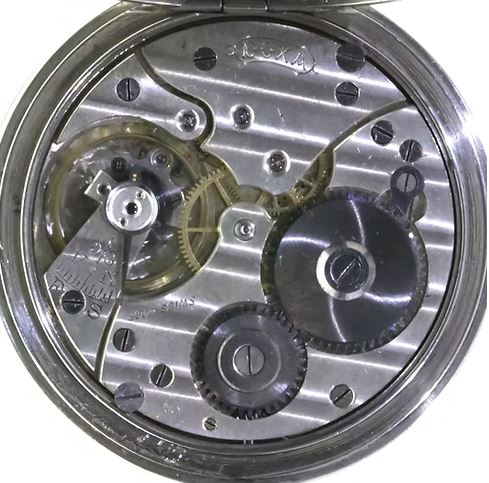
The watch has a high-quality, nickel-plated, 19 ligne movement, signed Doxa with fine Geneva Stripes to the top bridges. The movement is a straight-line lever with a club foot escapement, 15 jewels and a 30-hour power reserve. The compensated balance with a Breguet overcoil hairspring has a Bosley regulator and a balance cock scale engraved F S above the scale. The movement is clean and is keeping very good time.
Case and dial
The watch case measures 57mm in diameter, excluding the winding stem. The case is made from nickel, which is a much more durable material than the standard silver cases of the period. The caseback includes the underscored capital A with a broad arrow (pheon) pointing upward underneath it, which was a standard RFC issue. The ‘A’ represents ‘Aviation’ and the pheon indicates British government ownership. The black dial features white, non-luminous Arabic numerals and a subsidiary seconds dial. Although normally referred to as a cockpit watch, these were actually fitted into a bracket on the aircraft cockpit instrument panel and used like a clock. Many cockpit watches that survived the war and entered civilian life had a loop fitted to the winding stem, allowing them to be used like a pocket watch.
The dial is signed “30 HOUR NON-LUMINOUS MARK V”. Above the subsidiary seconds dial is “B.E. 12340”. The “B.E.” is the manufacturer’s code for Doxa, and the “12340” is the serial number. This could be noted in the pilot’s pay book, so if the cockpit watch was not returned, their pay could be docked. The mineral glass has light scratches, and the dial has two hairline cracks between 7 and 8 o’clock.
Summary
Although we have discussed WW1 cockpit watches in the past, this is the first time we have taken a close look at a specific watch. It is in great condition and working well. However, as an original cockpit watch, it lacks the bow or loop that allows it to link to a chain. This makes it less practical to use as a traditional pocket watch.
Related content
The Doxa website.