Last updated on September 9, 2026
The name Patek Philippe doesn’t appear very often in the pages of Time Worn Watches. This is most likely because the pockets of our group are far too shallow to consider the brand. However, in a recent meeting, one of the members referred us to an auction that occurred over ten years ago. The auction was held by Sotheby’s and involved one of the world’s most famous watches, the Henry Graves Jr. Supercomplication by Patek Philippe. At £13.4 million, it is still vastly out of our reach, but we thought we might share our research on the timepiece.
Henry Graves Jr.
Henry Graves Jr. (1868–1953) was born in Orange, New Jersey, into a distinguished banking family. Although he made his career as an investment banker, Graves’s true passion was collecting, especially of art and finely crafted watches. He is best known for commissioning some of the most elaborate timepieces ever made. In particular, Graves pushed Patek Philippe to design ever more complex watches. He famously competed with fellow collector James Ward Packard to outdo each other. Graves’s most famous commission was the gold pocket watch now called the Henry Graves Jr. Supercomplication, a masterpiece completed in 1933 with 24 complications (Henry Graves Jr. at Christie’s).
Patek Philippe, a brief history
Polish watchmaker Antoni Patek and his partner Franciszek Czapek founded the firm Patek, Czapek & Cie in 1839. After Patek ended his partnership with Czapek, French watchmaker Adrien Philippe (inventor of the keyless winding system) joined the company. In 1851, the firm was renamed Patek, Philippe & Cie and quickly earned a reputation for technical excellence. European royalty became clients early on. Queen Victoria herself acquired a Patek Philippe pendant watch at the 1851 Great Exhibition in London. The combination of complications (from perpetual calendars to repeater chimes) and high-quality craftsmanship earned Patek Philippe a position at the top of the luxury watch market (Patek Philippe at Wikipedia).
In 1932, the Stern family took control of the company. It still remains privately owned by the Sterns to the present day. Under the Stern leadership, Patek Philippe continued to innovate and deliberately maintained a low production volume. Patek Philippe only manufactures a few tens of thousands of watches per year to ensure exclusivity. The company now operates hundreds of boutiques and authorised dealers worldwide.
The Supercomplication
Henry Graves Jr. commissioned the Supercomplication in 1925 at a cost of 60,000 Swiss francs. Patek Philippe’s craftsmen worked on it for eight years. Completed in early 1933, the watch was delivered to Graves on 19 January of that year. It was explicitly designed to surpass a competing watch ordered by Packard, each man determined to possess the world’s most elaborate timepiece. The finished Supercomplication was a testament to human ingenuity in the pre-digital era. It contained 920 individual parts and, for many decades, held the record as the most complicated mechanical watch ever made.
Patek itself credits the Graves Supercomplication with “revolutionising watchmaking”. It remained the world’s most complex watch until Patek’s own Calibre 89 appeared in 1989. Graves’s patronage was also critically important for Patek Philippe. The orders from Graves provided essential income during the Great Depression. This helped the company stay afloat after the 1929 Crash. Over time, the Graves Supercomplication came to be regarded in watch circles as the “holy grail” of vintage watches.
Complications
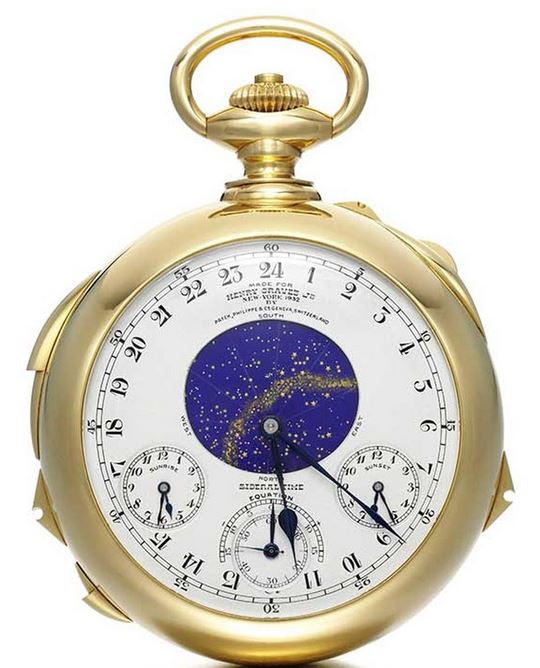
The Supercomplication earns its name from its remarkable set of 24 complications, which are features beyond simple timekeeping. As Sotheby’s describes in its auction catalogue, the watch includes a minute repeater with Westminster chimes, both a petite and grande sonnerie (automatically striking each quarter and hour), and a split-seconds chronograph with 60-minute and 12-hour registers. It has a perpetual calendar (accurate through the year 2100) with moonphase, an equation of time display, and dual power-reserve indicators (one for the timekeeping train and one for the chiming train). The dial also shows both mean time and sidereal (astronomical) time, and even has an alarm function.
On the case back side, there are indications for sunrise and sunset times, calibrated to Graves’s New York location, and a stunning celestial chart of the night sky as seen from his Fifth Avenue home. In other words, the watch can tell you the local time, the time by the stars, the calendar date, the day of the week, and much more – all in one gadget built by hand. Each of its two faces presents a clean layout of these functions (see image above), making the Supercomplication not only a technical wonder but also an object of beauty.
Auction results
The Henry Graves Supercomplication has repeatedly broken world records at auction. In 1999, it sold in New York for $11,002,500, then the highest price ever paid for a watch. Just 15 years later, at Sotheby’s Geneva in 2014, the watch sold again for CHF 23.2 million (about GBP £13.4 million). That sale more than doubled its previous record and set a new all-time high for any watch at auction. Today, the Supercomplication belongs to a private collection and is rarely seen by the public.
Related content
J. Player & Son ‘Hyper Complication’ pocket watch auction.