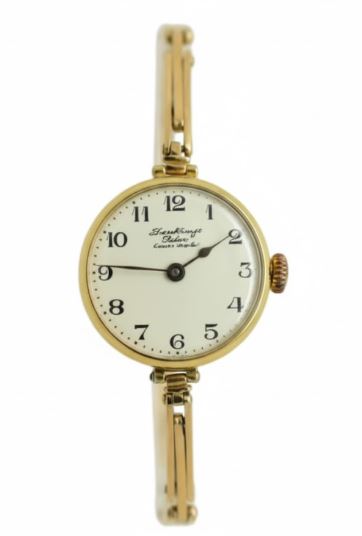
This is an interesting timepiece, not one that we would choose ourselves (it’s a ladies’ watch), but certainly one with an interesting history. It is a very well-presented and extremely rare 1920 ladies’ solid 18ct yellow gold Rolex retailed by the famous Dunklings store in Melbourne. It is in near-mint condition, although it has clearly been redialled. Most notably, the dial is co-branded with the Rolex and Dunklings names.
Interesting to note that Rolex only ever dual-branded with a select few retailers, Dunklings was amongst those. At the start of the 20th century, Wilsdorf & Davis, later known as Rolex, produced unbranded watches for jewellers to personalise. Jewellers added their own logos to the dials and sold the watches under their names, without the mention of Rolex. In the 1920s, Hans Wilsdorf ended this practice, determined that every Rolex watch display the brand and crown emblem. For a period, Wilsdorf permitted the co-branding of the Rolex name. This practice mainly occurred during the 1920s to the 1940s. Other names include Bucherer, Cartier, Tiffany, Fortnum & Mason and Asprey.
The history of Dunklings Jewellers, Melbourne
Dunklings was a leading jewellery retailer and manufacturer in Melbourne, Australia, operating from the mid-19th century until the 1990s. Brothers Julius, Gustav, and Adolph Dunkling founded the company in 1874 after migrating from Germany. Their store stood at 317 Bourke Street, Melbourne. Later, it became 313 Bourke Street, where the original “Dunklings Diamond House” was established in 1901. This became the “New Diamond House” in 1936.
Expansion
The business initially imported and sold jewellery and luxury items, including watches. In the early 20th century, Dunklings expanded into jewellery manufacturing. By the 1930s, it had become one of Australia’s largest jewellery manufacturers, praised for its fine craftsmanship and innovative design.
In an article from the Melbourne Advocate dated the 5th September 1935, Dunklings was praised for 50 golden years of service to the public. Customers praised their service and the quality of the jewellery they produced in their own large workshops. Additionally, customers could inspect high-grade watches to suit all classes of patrons. This range included co-branded Rolex watches.
During World War II, Dunklings shifted its manufacturing focus to military insignia, medals, and jewellery for the war effort. After the war, the company resumed producing jewellery and expanded its retail presence across Melbourne. In the 1960s and 1970s, Dunklings earned recognition for its modernist designs and use of unique materials like stainless steel and titanium. The business also further broadened its range to include luxury goods such as watches and giftware.
Demise
Despite its achievements, Dunklings encountered financial troubles in the 1980s. In 1995, Angus & Coote, a jewellery chain, acquired the company, ending Dunklings’ 121 years of independence. Angus & Coote, founded in Sydney in 1895, strengthened its national position by buying regional names like Dunklings. Some Dunklings stores retained independent branding after the takeover.
In November 2008, the parent company renamed all remaining Dunklings locations and other acquired brands to Angus & Coote to boost national recognition. Dunklings remains remembered as one of Melbourne’s most cherished and iconic jewellers (Dunklings, Melbourne at Carters Price Guide).
Case and dial
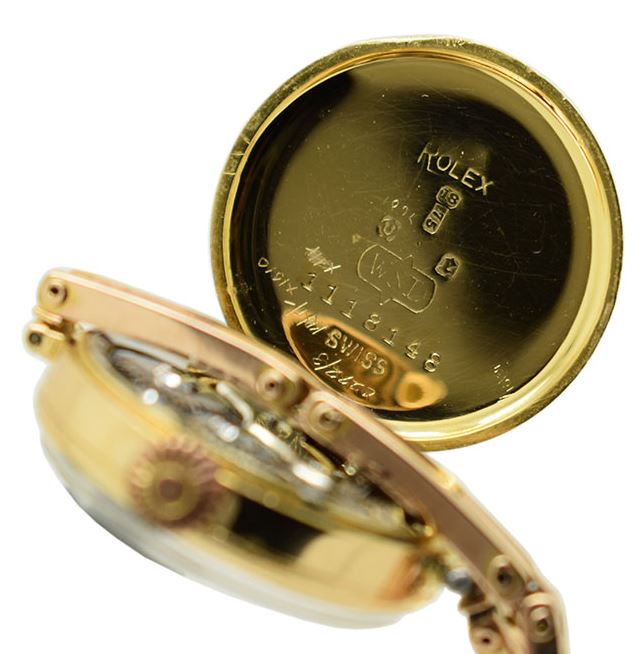
The rare top-quality solid 18ct gold double-hinged case is in superb condition, of the highest quality and good weight. It has been lightly polished. The case back features 18ct solid gold hallmarks, along with ‘ROLEX W&D 18.75’. The case measures 23mm in diameter, excluding the winding crown. There are some watchmaker’s service marks on the inside of the outer case. These are generally a good sign, as it indicates that previous owners had the watch serviced.
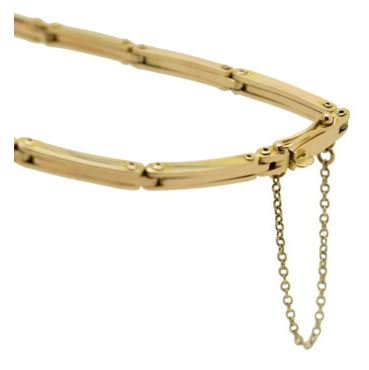
The high-grade, solid 15ct gold expanding link bracelet with safety chain is in mint condition. The bracelet fits a 16.5 cm wrist and has a side safety clasp, which displays a 15ct gold hallmark.
The satin silver dial is in mint condition and is a rare type. The dial has very attractive black Arabic numerals with contrasting gold dot minute markers, making them really stand out from the dial. The blue steel hands also contrast beautifully with the silver dial. The dial is signed ‘DUNKLINGS ROLEX SWISS MADE’.
Rebberg movement
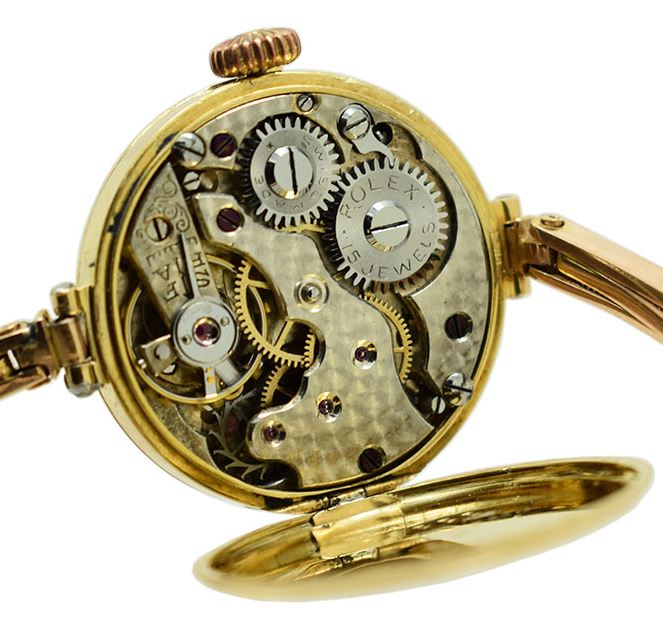
The high-grade manual-wind 15-jewel Swiss-made Rolex-Rebberg movement is in excellent condition. The movement has received a full service and is keeping excellent time over a 36-hour period. The movement is signed ‘ROLEX 15 JEWELS SWISS MADE’. I have not been able to track down the precise Rolex-Rebberg movement. However, the Rebberg brand maintained a reputation for high quality.
Rolex-Rebberg
Hans Wilsdorf and his brother-in-law, Alfred Davis, founded Rolex as Wilsdorf and Davis in London, England, in 1905. Hans Wilsdorf recorded that from its start, the aim of the company was to specialise in the distribution of quality timepieces. Wilsdorf was also an early advocate of the watch worn on the wrist. Wristwatches were not very precise at the time. However, Hans Wilsdorf had the foresight to believe that they could become not only elegant but also reliable.
Soon after founding the business, Wilsdorf ordered complete wristwatches from Herman Aegler, a Swiss watchmaker from Bienne, Switzerland. Wilsdorf knew Aegler had developed a new movement around 1902 that was suitable for wristwatches. This was later known as the Rebberg movement after the location of the factory. According to Mikrolisk, the horological trade mark index, Aegler SA registered the Rebberg trademark on the 21st January 1903.
In 1919, Wilsdorf purchased Alfred Davis’s share of Rolex, becoming the sole proprietor. The earliest watches from Wilsdorf and Davis were usually hallmarked “W&D” inside the caseback. However, even after the departure of Davis, W&D was still present on all hallmarked Rolex cases until about 1923. This was when Rolex introduced “RWC Ltd” as the sponsor’s mark.
Summary
An interesting watch, which looks to be in mint condition. However, this is a little deceptive, as it clearly is a redial with polishing to make the case look new. That said, it has an interesting history with links to Rolex and the Australian retailer, Dunklings. The watch was sold at the time of writing. Clearly, the near-mint condition of this extremely rare 1920 ladies’ “private label” Rolex watch captivated a collector.
Related content
Dating Rebberg watches at BHI.