Last updated on August 3, 2026
Pocket watches have shaped personal timekeeping for centuries, evolving from early mechanical curiosities into the refined objects of precision and beauty admired today. Central to their development is the way these watches are wound and powered. Two principal mechanisms defined this progress: the key-wound system, rooted in the earliest days of watchmaking, and the later stem-wound design, which transformed convenience and reliability. Examining the history and characteristics of each reveals not only how pocket watches function but also how changing technology shaped the very relationship between wearer and timepiece.
The traditional key-wound pocket watch
The key-wound pocket watch represents the earliest chapter in portable timekeeping. Originating in the sixteenth century, when mechanical watches began to appear in everyday life, these timepieces relied entirely on a separate winding key. The user inserted the key into a small aperture in the case, typically at the back, and turned it to tension the mainspring. The entire power supply of the watch depended on this manual winding ritual.
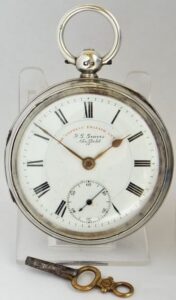
For centuries, the key-wound approach endured as the primary method of powering a personal timepiece. Its longevity speaks both to its simplicity and to the craftsmanship of early watchmakers who refined gears, barrels and balance assemblies long before other winding options existed. To wind a key-wound watch today is to share a sensory link with history. The resistance of the spring, the subtle clicks of the ratchet and the physical act of turning the key create a moment of connection between owner and object. Enthusiasts often enjoy the ritual of winding, and the respect it shows to the watchmaker’s craft (How are mechanical watches wound? At Monochrome).
Even after more convenient systems emerged in the nineteenth century, collectors continued to value key-wound watches for their charm, mechanical purity and the glimpse they offer into the earliest days of portable horology.
A brief history of key-wound pocket watches
In their earliest forms, key-wound watches were marvels of ingenuity. Sixteenth-century examples were often bulky drum-shaped objects, yet they were revolutionary because they brought timekeeping out of the church tower and onto the person. Over the following centuries, improvements in metallurgy, escapement design and spring manufacture enabled watchmakers to create smaller and more precise movements, all still wound with a key.
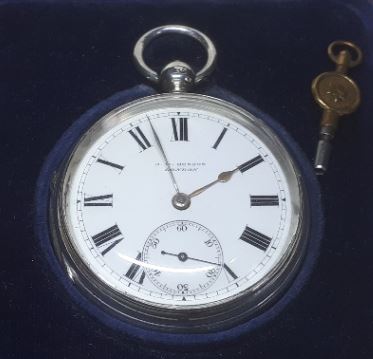
By the eighteenth and early nineteenth centuries, key-wound watches had reached a high point of elegance and mechanical refinement. Cases became finely engraved or engine-turned, while movements were increasingly jewelled and regulated. However, all still relied on the winding key, which could be elaborate in its own right. Many owners wore their keys on chains or kept them safely tucked away in a waistcoat pocket, aware that misplacing one meant a temporarily powerless watch (Key-wind, key-set movements at Wikipedia).
The arrival of the stem-wound mechanism in the mid to late nineteenth century marked a turning point, but the key-wound system never disappeared completely. It remains beloved among collectors who take pleasure in the historical authenticity and hands-on experience it provides.
The rise of the stem-wound pocket watch
The nineteenth century brought a revolution in watchmaking with the introduction of the stem-wound mechanism. This innovation replaced the external key with a winding crown integrated into the side of the case, usually at the twelve o’clock position for open-face watches or at three o’clock for hunter-case designs. Turning the crown wound the mainspring directly, offering immediate convenience and removing the risk of misplacing a winding key (Keyless work at Wikipedia).
How does it work?
The modern keyless watch utilises a crown on the case or pendant, connected to a stem, to operate the internal mechanism known as the keyless work. This mechanism ingeniously translates the crown’s rotation into either winding the mainspring or setting the time by shifting gears internally. The innovation of the keyless work eliminated the need for a separate key, spawning countless unique designs and patents. An early patent (No. 4501) was granted to Thomas Prest in 1820. Prest, an associate of chronometer maker John Arnold, described his invention as an “additional movement applied to a watch, to enable it to be wound up by the pendant knob without any detached key or winder” (Thomas Prest at The British Museum).
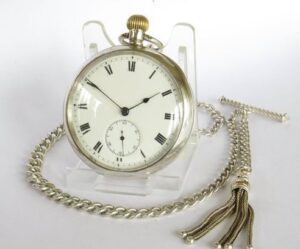
The stem-wound mechanism altered more than just access to winding. It paved the way for new functions, since the crown could also be used to set the hands and, in later pocket watches, to adjust additional complications such as the date. The change streamlined both the design and the daily use of the watch, ensuring that wearers could maintain accurate time wherever they happened to be.
Mass production
This new practicality quickly found favour among the public. As mass production expanded in the late nineteenth and early twentieth centuries, stem-wound watches became the standard, shaping the development of the modern wristwatch and securing the crown as a permanent feature of personal timekeeping.
On many French and Swiss pocket watches made after 1860, the word Remontoire stamped on the case indicated that the watch used a keyless winding system and did not require a key to wind. Technically, this was not correct. In mechanical watchmaking, a “remontoire” (from the French remonter, “to wind”) is a small secondary power source, typically a weight or spring, that drives the timekeeping mechanism. This was periodically rewound by the watch’s main power source, such as the mainspring.
The development of stem-wound pocket watches
Stem-wound pocket watches grew more sophisticated over time. Early designs required the user to press a small lever to set the hands, while later versions allowed the crown to be pulled into different positions for winding or setting. This innovation made daily use of a watch far more intuitive.
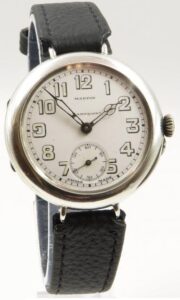
Manufacturers also took advantage of the stem-wound system to expand functionality. Features such as hacking seconds, calendar displays and multiple time zones became more obtainable. The greater protection of the internal mechanism from dust and moisture was another advantage, since the removal of a winding keyhole reduced entry points for debris. By the early twentieth century, the stem-wound mechanism had become the standard across the industry. When wristwatches rose to prominence during the First World War, they inherited the crown winding system directly from their pocket-watch predecessors (Keyless work at Vintage Watchstraps).
Comparing the two mechanisms
The most fundamental difference between key-wound and stem-wound watches lies in how the user transmits energy to the mainspring. A key-wound watch requires a separate key inserted through a designated opening. This creates a deliberate process that feels ceremonial and intensely mechanical. In contrast, a stem-wound watch integrates the winding mechanism into the crown, allowing the wearer to easily wind and set the time. Either method was available as an option for quite some time, as shown by the J.G. Graves advertisement below.
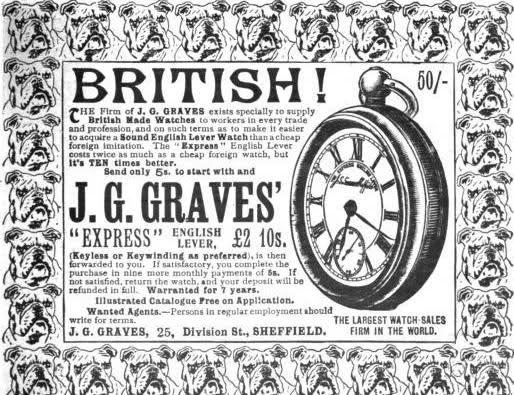
While stem-wound watches offer convenience, key-wound pieces hold their own appeal. The design of the movement often differs, and many key-wound watches feature beautifully traditional layouts with clear evidence of hand-finishing. Each approach reflects different eras and philosophies of watchmaking. There is, of course, always the chance that you can lose a key. Replacements are easy to source, but losing the original key can have a serious impact on authenticity.
The appeal of key-wound watches
Key-wound pocket watches embody an age of meticulous handcraft. Their construction required extraordinary skill, and the winding ritual forms part of the experience. Collectors often describe a sense of stepping into the past when handling these timepieces. The gentle resistance of the mainspring, the play of light on the casework and the rhythm of the ticking movement combine to create a uniquely romantic impression. Owning a key-wound watch is not simply about telling the time. It is about appreciating a mechanical tradition that predates industrialisation and continues to inspire modern watchmakers.
The practical benefits of stem-wound watches
Stem-wound pocket watches represent a major leap forward in everyday reliability. They are easier to wind, simpler to set and generally more practical for frequent use. Their more robust cases protect the movement better, and their consistent winding action can contribute to improved accuracy. As a result, the stem-wound design became the dominant choice for both pocket watches and wristwatches. For anyone seeking usability and precision without the need for accessories, a stem-wound pocket watch remains the natural option.

Choosing a pocket watch that suits you
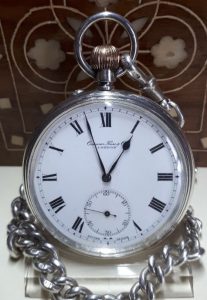
Selecting a pocket watch involves more than comparing winding mechanisms. Consider the materials, design, intended use and personal taste. A key-wound watch may appeal to those who admire traditional craftsmanship and enjoy the tactile involvement of manual winding. A stem-wound watch may suit those who prioritise convenience, daily accuracy and ease of use. Whether crafted from gold, silver or steel, whether ornate or understated, the right pocket watch should feel like an extension of your style and an object worthy of care. These are obviously fragile pieces, without the shock protection systems available in more modern watches. They are probably more suitable for special occasions rather than an everyday watch. Secure storage and regular maintenance are important to ensure these timepieces will survive for future generations.
Summary
Key-wound and stem-wound pocket watches each tell a different story in the long history of watchmaking. Key-wound pieces speak of early mechanical ingenuity, artisanal skill and the intimate ritual of winding with a key. Stem-wound watches reflect progress in design and practicality, shaping the way modern timepieces work today. Both approaches carry their own charm, and both continue to attract collectors, historians and enthusiasts. Together, they illustrate not only how pocket watches were powered, but also how human interaction with technology has evolved over centuries.
Related content
Mechanical watch at Wikipedia.