Last updated on January 10, 2026
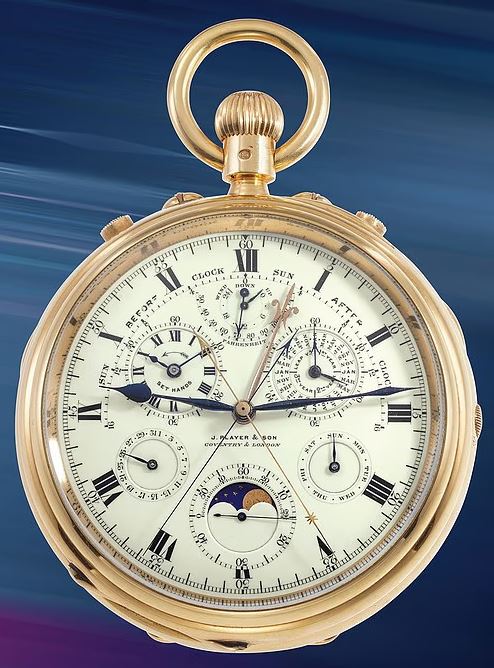
The J Player & Sons 1907 pocket watch, known as the “Hyper Complication,” stands as an extraordinary benchmark in the final years of the pocket watch era. The very title, “Hyper Complication”, speaks of the watch’s significance, which stems directly from the ten distinct mechanical complications packed within its case. This pocket watch emerged just before the early 20th century witnessed a definitive shift towards wristwatches and the decline in popularity of pocket watches. The auction and the watch were brought to the attention of the Time Worn Watches group over a recent celebratory dinner. We decided to research the “Hyper Complication” and share what we found.
Phillips auction results
The J Player & Sons Hyper Complication was offered at auction by Phillips. The auction house included the watch as Lot 39 in its high-profile “Decade One” sale, in Geneva on 8 and 9 November 2025. The watch’s final sale price dramatically surpassed its conservative pre-sale estimate, which ranged from CHF 400,000 to CHF 800,000. It set a new record with auctioneers Phillips Watches confirming it sold for 2,238,000 Swiss francs, equivalent to £2,122,896.
The firm, J Player & Son, whose signature graces the watch, served as the high-end retailer and commissioner of the watch. J Player & Son was operating out of Coventry, a city historically central to the English watch and clock industry, providing the necessary infrastructure for a specialised high-end operation. The watch’s movement originated with Nicole, Nielsen & Co. in London, which completed the monumental mechanism and integrated the dizzying array of functions. The history of Nicole, Nielsen establishes its immense technical pedigree, tracing its foundation to Nicole & Capt in 1839. The company later evolved into Nicole, Nielsen & Co. around 1888 when Danish watchmaker Sophus Emil Nielsen joined the partnership. The firm was recognised as pioneering, notably inventing the modern chronograph and the rattrapante or split-seconds mechanism, both of which are central to the Hyper Complication.
Manufacture
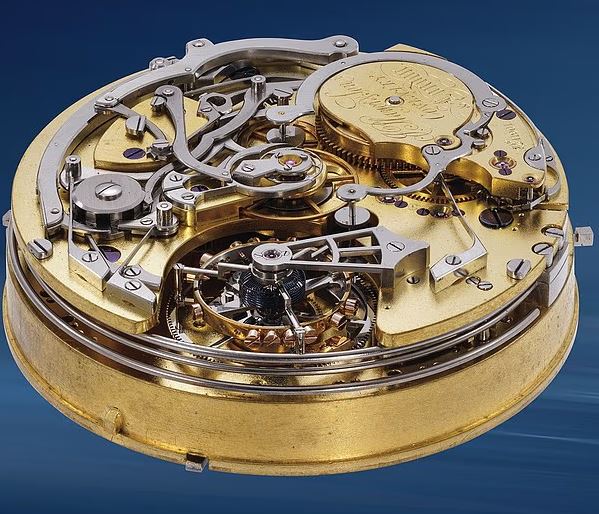
The J. Player & Son ‘Hyper Complication’ pocket watch was made in 1907. It measures an impressive 77mm in diameter and combines virtually every complication known to watchmaking at the turn of the 20th century. This open-face pocket watch sits in an 18ct yellow gold case. The watch began as an ebauche created by Louis Elisée Piguet (LEP), a leading etablisseur in the Vallée de Joux specialised in complications. It arrived in London in 1903, but without the necessary tourbillon mechanism installed. Nicole, Nielsen & Co. then undertook the immense task of integrating the comprehensive complication suite, including the intricate tourbillon. The process took four years.
Complications
The watch demonstrates the technical prowess of the English watchmaking industry at the time. The ten complications that the ‘Hyper Complication’ pocket watch features are rarely seen together:
Grande and petite sonnerie striking on three gongs.
The Grande Sonnerie chimes the hours on the hour and repeats both the hours and the quarter-hours at every quarter. The Petite Sonnerie is a variation that announces the quarters but limits the hourly strike to the hour only.
Carillon trip minute repeater.
This mechanism allows the wearer to trigger the sequential striking of the hours, the quarters, and the minutes on demand. The Carillon signifies a superior acoustic signature, achieved through the use of three gongs instead of the standard two.
Split-seconds chronograph with 60-minute register.
The chronograph measures elapsed time and is otherwise known as a stopwatch. The split-seconds feature allows the wearer to time two separate events simultaneously. This happens without needing to reset the initial timing sequence.
Perpetual calendar with leap-year indication.
This highly complex mechanism automatically adjusts for the irregular lengths of the months. This correctly accommodates months with thirty or thirty-one days. It also calculates the extra day in February during every four-year leap cycle, thus mechanically mirroring the Gregorian calendar.
Moon-phases and age of the moon.
This function displays the lunar cycle. It also indicates the precise number of days that have elapsed since the last new moon.
Equation of time.
This complication calculates the constantly changing difference between mean solar time and true solar time. This compares clock time versus the time measured by the sun’s actual passage across the meridian. True solar time varies throughout the year due to the Earth’s elliptical orbit and axial tilt.
Alarm.
The alarm, perhaps the most recognisable complication of the group, is a separate mechanism that sounds an audible reminder at a pre-set time.
Bimetallic thermometer.
This functional complication provides a readout of ambient temperature. It operates based on the principle of differential expansion. Two metal strips, laminated together, warp and move an indicator as they are exposed to temperature changes.
Power reserve indicator.
The watch has high energy demands from its constant striking and timing functions. The power reserve gauge provides an essential tool. It visually displays the remaining tension stored within the mainspring.
Tourbillon.
This component is essential for timekeeping precision. The tourbillon houses the balance wheel and escapement within a delicate rotating carriage. This turns continuously to average out the positional timing errors caused by gravity when the watch is in a fixed position.
All of these complications are elegantly arranged with exceptional balance and clarity on the beautiful dial crafted by Frederick Willis. The power reserve sits at 12 o’clock, encircled by the Fahrenheit thermometer. The alarm display, adjustable to the exact minute, appears near 10 o’clock, while the month and leap-year indicators are positioned around 2 o’clock. An arc-shaped gong stretching from 9 to 3 o’clock presents the Equation of Time. At 4 o’clock is the month indicator, the moon phases are shown at 6 o’clock, and the date is placed at 8 o’clock.
Family connections
Carl Player, 31, from Coventry, said the antique was made by his great-great-grandfather. Mr Player, who attended the auction in Geneva, said, “The day before they invited us to the exhibition, so I actually got to hold the watch…. Even though I didn’t meet my great-great grandfather, by holding that watch, I felt a connection to him”. Phillips said the identities of the sellers and buyers were confidential. However, Mr Player believed that the owner, who acquired it in 1974, had kept it for 51 years, was British or American, and “He didn’t want his name in the paper”. A spokeswoman for the Phillips said the “two-day, white-glove sale” had 1,885 registered bidders across 72 countries. “Almost 800 collectors and enthusiasts attended the auction in person,” the spokeswoman said, “and the atmosphere throughout the weekend reflected a sense of friendship and celebration”.
Summary
It’s an interesting watch, not one that any of the Time Worn Watches group would like to own. The servicing costs, not to mention the insurance, would be astronomical! It is the second significant auction result last month, including the Isidor Straus Titanic pocket watch sale on 22nd November 2025. These are two amazing technical works of art that survived, fully functional for over a century. Both are a testament to the watchmakers who crafted these extraordinary timepieces.
Related content
Complicated’ watch from 1907 sets world record at auction at the BBC News.