In previous Time Worn Watches articles, the military focus has nearly always been on trench watches. In this post, we thought we might turn our attention to the use of pocket watches by the military. Naturally, this will focus on the First World War period.
Military pocket watches possess a history stretching back to the sixteenth century, when commanders recognised that reliable timekeeping could shape the success or failure of a campaign. Long before wristwatches entered the field, the pocket watch became an indispensable instrument for soldiers, sailors and early aviators. Over the centuries, these timepieces evolved in response to changing technologies, new forms of warfare and the increasing need for precision. Their durability and functional elegance have ensured their survival not only as field equipment but as highly prized collector’s items. Today, enthusiasts admire them for their engineering, historical significance and direct connection to the development of military culture.
This article explores the origins of the military pocket watch, the qualities that made it a trusted companion in harsh conditions, and the role it played across the armed forces. It also contrasts the pocket watch with the later trench watch, examining how the shift from pocket to wrist reflected broader changes in military practice.
Trench watches
Before the First World War, the pocket watch served as the principal timekeeping device for military operations. Manufacturers produced solid, often oversized cases that protected movements against dirt, shock and moisture. Officers in the Army relied on these watches to coordinate troop movements, while naval officers used them during navigation and signalling. Pilots of early air services carried pocket watches into the cockpit, often secured in special holders to keep them visible during flight.
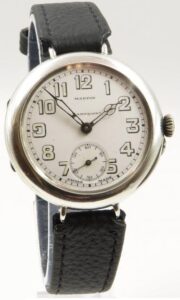
The outbreak of the First World War placed fresh demands on battlefield timekeeping. Soldiers needed a way to read the time instantly while keeping their hands free, particularly during night operations or in the confined environment of a trench. This need spurred the widespread adoption of the wrist-worn trench watch. These early wristwatches incorporated luminous paint for low-light visibility and, in some cases, simple chronograph or stop-seconds features to support artillery timing and coordinated assaults. Although the wristwatch later became the dominant form of military timepiece, the pocket watch remained important throughout the conflict, particularly among officers and technical branches.
While civilian men had worn wristwatches for niche activities like cycling or ballooning before WW1, a pocket watch was the standard for a gentleman. The war served as the catalyst for change. The rapidly expanding army exposed countless new recruits to officers who habitually wore wristwatches. Serving on the front line gave these officers the confidence to keep wearing their wristwatches even when at home on leave, a practice they might have avoided pre-war. The visibility of officers on leave sporting wristwatches soon established a fashion that became common across British society.
Accuracy and resilience in the field
Accuracy and resilience determined whether a timepiece could meet the demands of military service. Precise timekeeping enabled units to synchronise their movements, whether coordinating an infantry attack, timing a naval bombardment or calculating the position of an aircraft using early navigation methods. A delay of only a few seconds could lead to confusion on the battlefield or misalignment between units operating across difficult terrain.
Durability mattered just as much. Military pocket watches needed to function amid extremes of temperature, repeated impact and exposure to the elements. Army officers might carry their watches through mud-filled trenches, naval personnel faced salt spray and humidity, and early aviators endured rapid changes in temperature and vibration. A dependable watch reassured its owner that, whatever the conditions, the mechanism would continue to keep accurate time.
Early Designs
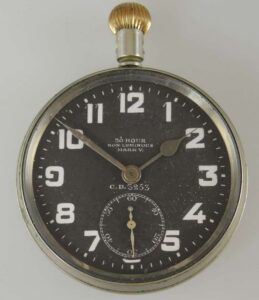
Technological advances in metallurgy and manufacturing during the nineteenth and early twentieth centuries dramatically improved the performance of military pocket watches. Stronger alloys allowed for protective cases capable of surviving shocks that would destroy a civilian timepiece. Better machining techniques produced movements with tighter tolerances, enhancing accuracy and reliability. By the time of the First World War, many military pocket watches included strengthened balance wheels, upgraded mainsprings and dust-resistant cases designed specifically for field conditions.
Although later innovations such as computer-aided design and modern alloys would influence military wristwatches, the foundation of ruggedness and reliability was firmly established by the pocket watches of the late Victorian and Edwardian eras.
Active service
During active operations, pocket watches delivered the dependable timing that soldiers, sailors and airmen required. Many carried watches with luminous hands or numerals to ensure legibility during night manoeuvres, while some models incorporated secondary functions such as elapsed-time indicators for artillery spotting or naval signalling.
Military pocket watches also needed to resist severe shock and vibration, especially in the engine rooms of Royal Navy vessels or in the open cockpits of early aircraft. Their size and robust build helped them withstand these challenges. In the field, officers used their watches to coordinate reconnaissance patrols, synchronise barrages and maintain order across dispersed units.
Service in Every Branch
At sea, accurate, stable timekeeping determined a ship’s longitude and allowed squadrons to coordinate manoeuvres across miles of open water. Deck watches and robust pocket watches formed part of the navigator’s essential kit and were adapted to withstand salt, humidity and the heavy knocks of shipboard life. Many Royal Navy pieces survive with service markings, and auction records attest to the use of both British makers and Swiss movements in naval service watches.
In the early air forces, including the Royal Flying Corps and later the Royal Air Force, pilots relied on pocket watches for flight planning, navigation and timing bombing runs. Aviators often fitted their pocket watches in simple holders so they could time legs and bombing runs with a glance. As aerial operations became more complex, watches with centre seconds or chronograph functions gained value for navigation and synchronised missions (Mark IV.A and Mark V cockpit watches at Monochrome).
On land, officers used pocket watches to coordinate troop movements and to synchronise night attacks and artillery barrages. The severe mud and water of the trenches demanded watches with protective cases and clear dials. Even as trench watches became more common for front-line infantry, pocket watches remained important for staff officers, engineers and artillery crews who needed a stable, serviceable instrument.
Water resistance
War zone conditions exposed a critical flaw in watches: their vulnerability to water entering through the unsealed case or the crown and winding stem. While Ezra Fitch patented an early screw-down crown in 1881, the true leap in water resistance was achieved by François Borgel in 1891. Borgel’s revolutionary patent described a two-piece pocket watch case that immediately improved sealing. The watch movement, dial, and crystal were fitted into a single carrier ring, which then screwed directly into the case front. The extremely fine threading created a tight, reliable barrier against dust and moisture.
Crucially, Borgel avoided the unreliable screw-down crowns of the era, which accumulated dust and wore out quickly. Instead, he used a split stem and a spring assembly that kept constant downward tension on the crown, ensuring a seal. Since gaskets of the 1890s (such as waxed cotton or string) were of poor quality, Borgel relied on high-precision metal-to-metal contact for water resistance, a strategy that proved effective enough that his cases were known to survive after being submerged for days. As World War I established the wristwatch (“wristlet”) as a vital military tool, Borgel scaled down his two-piece design. Though wristwatches with Borgel cases existed before the war, their production surged during the conflict, with brands like Longines becoming key clients (How Borgel and Taubert revolutionised water resistance at Time + Tide).
Related content
WW1 Military Watches at Chronopedia.